
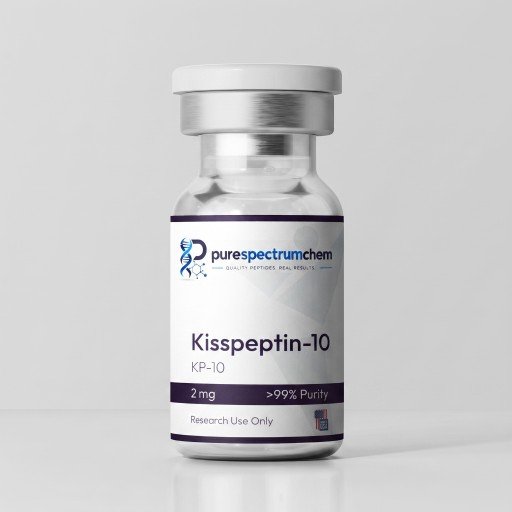
What Is Kisspeptin?
Kisspeptin refers to a family of peptides encoded by the KISS1 gene, with Kisspeptin-10 (KP-10) being the most studied active fragment in reproductive research. It plays a critical role in the regulation of the hypothalamic–pituitary–gonadal (HPG) axis.
Initially discovered as a metastasis-suppressor protein encoded by the KISS1 gene, Kisspeptin is now primarily recognized for its ability to stimulate gonadotropin-releasing hormone (GnRH) secretion, making it a key focus in reproductive endocrinology research.
In laboratory settings, Kisspeptin is typically supplied in synthetic form for preclinical studies. It is water-soluble and stable under standard peptide storage conditions when kept lyophilized and protected from light and moisture.
Researchers frequently explore its effects on pubertal onset, fertility regulation, and neuroendocrine signaling, as well as its emerging roles in behavior, metabolism, and cancer biology.
| Note: Kisspeptin is supplied for research use only. It is not approved for human or veterinary use, and must not be used for therapeutic, diagnostic, or clinical applications. |
Kisspeptin Mechanism of Action
Kisspeptin plays a pivotal role in regulating reproductive physiology through its action on the hypothalamic–pituitary–gonadal (HPG) axis. Its primary mechanism involves stimulating the secretion of gonadotropin-releasing hormone (GnRH), which subsequently regulates luteinizing hormone (LH) and follicle-stimulating hormone (FSH) production.
Receptor Binding and Signal Transduction
Kisspeptin exerts its effects by binding to the KISS1 receptor (KISS1R or GPR54), a G protein-coupled receptor expressed on GnRH neurons in the hypothalamus. Upon binding, the receptor activates intracellular signaling pathways involving phospholipase C (PLC), leading to the generation of inositol trisphosphate (IP₃) and diacylglycerol (DAG).
This cascade increases intracellular calcium levels and activates MAPK pathways (ERK1/2, p38), ultimately leading to GnRH neuron depolarization and secretion [1].
Activation of GnRH and the Pituitary Axis
Animal studies and in vitro assays have demonstrated that kisspeptin administration robustly stimulates GnRH release, which in turn increases LH and FSH secretion from the anterior pituitary. This makes kisspeptin essential for pubertal initiation and reproductive cyclicity [2].
Role in Puberty and Sexual Maturation
Genetic studies show that loss-of-function mutations in either KISS1 or KISS1R lead to hypogonadotropic hypogonadism, characterized by delayed or absent puberty and infertility. Conversely, gain-of-function mutations can cause precocious puberty, affirming the peptide’s role as a master regulator of reproductive onset [3].
KNDy Neurons and GnRH Pulsatility
In the arcuate nucleus, kisspeptin is co-expressed with neurokinin B and dynorphin—forming the so-called KNDy neurons. These neurons regulate the pulsatile secretion of GnRH, which is critical for normal reproductive hormone release. Neurokinin B provides excitatory input, while dynorphin contributes inhibitory signals, and kisspeptin acts as the principal output driving GnRH neuron activity [4].
Emerging Roles in Non-Reproductive Biology
Although best known for its reproductive effects, kisspeptin has also shown activity in other physiological systems.
In murine models, it appears to enhance glucose-stimulated insulin secretion from pancreatic beta cells. However, these effects are context-dependent and not replicated by central nervous system administration [5].
Additional research has identified kisspeptin and its receptor in the limbic system, suggesting roles in behavior, mood, and stress regulation, although these findings remain under investigation [1].
Remember, these mechanisms have been elucidated primarily in animal models, in vitro studies, and limited human observational research. Kisspeptin is intended for research use only and is not approved for clinical, diagnostic, or therapeutic applications.
Research Applications (Kisspeptin Benefits)
Kisspeptin, a neuropeptide encoded by the KISS1 gene, has emerged as a pivotal regulator of human reproductive physiology. Initially identified for its role in initiating puberty, kisspeptin is now recognized for its broader influence across the reproductive axis, metabolic signaling, emotional behavior, and placental biology.
Preclinical and clinical studies continue to expand its therapeutic potential, from treating infertility and hypogonadism to modulating reproductive timing in response to nutritional cues.
As evidence accumulates, kisspeptin’s multifaceted actions position it as a promising target for both reproductive medicine and metabolic health interventions.
Reproductive Axis Activation
Kisspeptin serves as a key upstream regulator of the hypothalamic–pituitary–gonadal (HPG) axis by stimulating GnRH secretion via activation of its receptor, KISS1R.
When exogenous kisspeptin is applied in vitro or in vivo, it triggers a rapid release of gonadotropin-releasing hormone (GnRH), which in turn stimulates luteinizing hormone (LH) and follicle-stimulating hormone (FSH) release from the pituitary. This cascade underlies essential reproductive events, including pubertal onset and ovulation [2].
Genetic evidence reinforces this, as loss-of-function mutations in KISS1 or KISS1R cause hypogonadotropic hypogonadism, demonstrating that kisspeptin signaling is necessary for sexual maturation . Conversely, gain-of-function mutations result in precocious puberty, further highlighting its central role [7].
Animal models, especially rodents and primates, have shown that controlled administration of kisspeptin can not only induce gonadotropin pulses but even synchronize ovarian cycles and advance puberty onset [8].
Metabolic Regulation and Energy–Reproduction
Emerging evidence indicates that kisspeptin neurons play a pivotal role in integrating metabolic signals with reproductive status [9].
In rodent fasting models, decreased leptin and energy availability reduce Kiss1 gene expression in hypothalamic arcuate neurons, leading to suppressed LH secretion and delayed puberty onset. Reversing negative metabolic conditions—for instance, via leptin supplementation or food refeeding—restores Kiss1 expression and normalizes gonadotropin release [7].
This influence is further supported by the presence of metabolic hormone receptors (e.g., leptin, ghrelin) on kisspeptin neurons, suggesting direct sensing of peripheral energy cues.
Additionally, elevated kisspeptin levels during obesity and diabetes indicate a complex interplay where metabolic dysregulation perturbs reproductive signaling . These findings position kisspeptin as a metabolic gatekeeper, linking nutrient status to reproductive readiness—an area of ongoing interest in fertility and endocrinology research.
Peripheral and Emerging Roles in Reproduction and Behavior
Beyond central GnRH activation, kisspeptin and its receptor are also expressed in peripheral reproductive tissues (ovaries, testes, placenta), indicating local, autocrine or paracrine roles [4].
Recent studies have documented kisspeptin’s role in promoting oocyte maturation in the ovary via both systemic gonadotropin release and direct activation of ovarian receptors, which enhance granulosa cell function and meiotic progression [10].
In livestock models, engineered kisspeptin analogs have demonstrated the ability to synchronize ovulation and induce fertile breeding cycles—highlighting kisspeptin’s utility in reproductive biotechnology [8].
Additionally, kisspeptin signaling extends into brain regions tied to emotion and behavior; rodent studies suggest it can influence sexual motivation, partner-preference behaviors, and anxiety-like responses [4].
Kisspeptin Characteristics
- Molecular Formula: C₆₃H₈₃N₁₇O₁₄
- CAS Number: 374675‑21‑5
- Amino Acid Sequence: Tyr–Asn–Trp–Asn–Ser–Phe–Gly–Leu–Arg–Phe‑NH₂ (YNWNSFGLRF-NH₂)
- Metastin (45‑54), Kisspeptin‑10, KP‑10
- Molar Mass: ~1302.4–1302.5 g/mol
- PubChem CID: 25240297
- Purity: ≥99%, lyophilized powder
- Appearance & Solubility:
- White (off‑white) lyophilized powder; soluble in water (up to 1 mg/mL) and polar solvents such as DMSO
- Storage Recommendations:
- Store sealed at ≤ 8 °C short-term or –20 °C or colder long-term; protect from light and moisture
Kisspeptin vs GnRH vs LHRH (Research Comparison Table)
| Feature | Kisspeptin‑10 | GnRH (LHRH) | Neurokinin B (NKB) |
| Peptide Type | Decapeptide neuropeptide | Decapeptide hypothalamic hormone | Decapeptide tachykinin neuropeptide |
| Target Receptor | KISS1R / GPR54 | GnRHR (GnRH receptor) | NK3R (Neurokinin receptor 3) |
| Sequence | YNWNSFGLRF‑NH₂ | pGlu‑His‑Trp‑Ser‑Tyr‑Gly‑Leu‑Arg‑Pro‑Gly‑NH₂ | DMHDFFVGLM‑NH₂ |
| Molecular Weight | ~1302.5 g/mol | ~1182.3 g/mol | ~1210.4 g/mol |
| Formula | C₆₃H₈₃N₁₇O₁₄ | (varies) | C₅₅H₇₉N₁₃O₁₄S₂ |
| Primary Research Use | Puberty onset, reproductive signaling, fertility, neuroendocrine modulation | Fertility models, hormone release, tumor signaling | Reproduction regulation, KNDy neuron studies |
| Mechanism | Upstream GnRH activation via KISS1R | Direct pituitary stimulation via GnRHR | Regulates GnRH pulsatility via NK3R in KNDy neurons |
| Preclinical & Clinical | Animal models & some early human observational studies | Both animal and human therapeutic/clinical use | Animal & first-in-human infusion studies |
| Purity (Research Grade) | ≥99% (Evolve Peptides) | Typically ≥95–99%, vendor-dependent | ≥95% |
| Regulatory Status | Research use only | Research or clinical; analogs FDA-approved | Research use only |
| Disclaimer | Not for human or veterinary use | Not for human or veterinary use | Not for human or veterinary use |
Neurokinin B (NKB) is co-expressed with kisspeptin and dynorphin in KNDy neurons. It modulates GnRH pulsatility and is essential for reproductive axis function, even though early human infusion studies in healthy volunteers didn’t significantly alter hormones.
GnRH and its analogs (often referred to as LHRH) have broader therapeutic development, including applications in fertility treatment and hormone-dependent cancers.
Kisspeptin Safety & Side Effects (Preclinical Studies)
Most available safety data for kisspeptin (including Kisspeptin-10, aka KP‑10) comes from animal models and limited early-phase human trials.
In a 14-day repeat-dose toxicity study in beagle dogs (30–1,000 μg/kg IV daily), KP‑10 was well tolerated. No adverse clinical signs, changes in body weight, organ pathology, ECG, or respiratory issues were observed—identifying 1,000 μg/kg as a No Observed Adverse Effect Level (NOAEL) [11].
In rodent safety studies, KP‑10 similarly demonstrated a high safety margin, with no significant toxicity even at doses exceeding typical research levels.
Similarly, in early human data, intravenous or intranasal kisspeptin administration in healthy men and women has been well tolerated, with no serious safety concerns identified [12].
One rodent study noted potential pro-atherosclerotic effects in ApoE‑/‑ mice at continuous, high-dose KP‑10 infusion—though relevance to typical research dosing and healthy models remains uncertain [13].
Certificate of Analysis (COA)
At Evolve Peptides, quality and transparency are paramount when it comes to research peptides like Kisspeptin‑10. Each batch undergoes rigorous, independent third-party analysis to ensure it meets our exacting standards:
- Purity (≥99%), verified via HPLC
- Identity confirmation through mass spectrometry
- Contaminant screening, including checks for endotoxins and heavy metals
Every Kisspeptin‑10 product page includes a downloadable COA link—batch‑specific and easily accessible. The COA allows you to verify the exact peptide vial you receive, ensuring consistent and reliable research performance.
Legal Disclaimer
At Evolve Peptides, we only sell Kisspeptin-10 for laboratory research use only. It is not approved for human or veterinary consumption, and must not be used for therapeutic, diagnostic, or medical purposes.
This product is not a drug, food, or supplement, and has not been evaluated by the FDA. By purchasing, you agree to use it in accordance with all applicable laws and confirm that it will be handled only by qualified professionals in controlled research settings.
Scientific References
- Mills, E. G., Yang, L., Abbara, A., & Dhillo, W. S. (2022). Current perspectives on kisspeptin’s role in behaviour. Frontiers in Endocrinology, 13, Article 928143. https://www.frontiersin.org/journals/endocrinology/articles/10.3389/fendo.2022.928143/full
- Skorupskaite, K., George, J. T., & Anderson, R. A. (2014). The kisspeptin–GnRH pathway in human reproductive health and disease. Human Reproduction Update, 20(4), 485–500. https://pmc.ncbi.nlm.nih.gov/articles/PMC4063702/
- Clarke, H., & Dhillo, W. S. (2015). Kisspeptin across the human lifespan: Evidence from animal studies and clinical interventions. Journal of Endocrinology, 224(3), R141–R153. https://www.ncbi.nlm.nih.gov/pmc/articles/PMC4508256/
- Xie, Q., Kang, Y., Zhang, C., Xie, Y., Wang, C., Liu, J., Yu, C., Zhao, H., & Huang, D. (2022). The role of kisspeptin in the control of the hypothalamic–pituitary–gonadal axis and reproduction. Frontiers in Endocrinology, 13, Article 925206. https://www.frontiersin.org/journals/endocrinology/articles/10.3389/fendo.2022.925206/full
- Bowe, J. E., King, A. J., Kinsey‑Jones, J. S., Foot, V. L., Li, X. F., O’Byrne, K. T., Persaud, S. J., & Jones, P. M. (2009). Kisspeptin stimulation of insulin secretion: Mechanisms of action in mouse islets and rats. Diabetologia, 52(5), 855–862 https://link.springer.com/article/10.1007/s00125-009-1283-1
- Wahab, F., Atika, B., Ullah, F., Shahab, M., & Behr, R. (2018). Metabolic impact on the hypothalamic Kisspeptin–Kiss1r signaling pathway. Frontiers in Endocrinology, 9, Article 123. https://www.frontiersin.org/journals/endocrinology/articles/10.3389/fendo.2018.00123/full
- Decourt, C., Robert, V., Anger, K., Galibert, M., Madinier, J.-B., Liu, X., Dardente, H., Lomet, D., Delmas, A. F., Caraty, A., Herbison, A. E., Anderson, G. M., Aucagne, V., & Beltramo, M. (2016). A synthetic kisspeptin analog that triggers ovulation and advances puberty. Scientific Reports, 6, Article 26908. https://www.nature.com/articles/srep26908
- Navarro, V. M., Gottsch, M. L., Wu, M., García-Galiano, D., Hobbs, S. J., Bosch, M. A., … Steiner, R. A. (2022). Kisspeptins and the neuroendocrine control of reproduction: Recent progress and new frontiers in kisspeptin research. Frontiers in Neuroendocrinology, 65, 100977. https://www.sciencedirect.com/science/article/pii/S0091302221000790
- Masumi, S., Lee, E. B., Dilower, I., Upadhyaya, S., Chakravarthi, V. P., Fields, P. E., & Rumi, M. A. K. (2022). The role of kisspeptin signaling in oocyte maturation. Frontiers in Endocrinology, 13, 917464. https://www.frontiersin.org/journals/endocrinology/articles/10.3389/fendo.2022.917464/full
- Murray, R. D., Lyons, D. O., & Samuels, M. L. (2020). Safety evaluation of KP‑10 (metastin 45–54) following once‑daily intravenous administration in beagle dogs. Regulatory Toxicology and Pharmacology, 111, 104555. https://pmc.ncbi.nlm.nih.gov/articles/PMC8277707/
- Dhillo, W. S., Chaudhri, O. B., Patterson, M., Thompson, E. L., Murphy, K. G., Badman, M. K., … Bloom, S. R. (2021). Translating kisspeptin and neurokinin B biology into clinical applications. Frontiers in Endocrinology, 12,9788075. https://pmc.ncbi.nlm.nih.gov/articles/PMC9788075/
- U.S. Food and Drug Administration. (2024, July 5). FDA evaluation of Kisspeptin‑10 for inclusion on the 503A bulk drug substances list. https://www.fda.gov/media/182089/download
Reviews
There are no reviews yet.